Gaussian Mixture Models — AIC, AICc, and BIC Model Selection#
What is a Gaussian Mixture Model?#
Imagine you have a scatter plot of data and you can see a few separate clusters. A Gaussian Mixture Model (GMM) formalises that intuition: it assumes the data came from K overlapping “blobs”, each shaped like a multivariate Gaussian (bell curve). We do not know K ahead of time — that is the whole point of this example. [1] [2] [3] [4] [5]
Mathematically, the model says:
p(x | θ) = Σ_j α_j · N(x | μ_j, Σ_j) for j = 1 … K
where:
K    — number of blobs (unknown, to be selected)
α_j  — how big / common blob j is          (all α_j sum to 1)
μ_j  — centre of blob j
Σ_j  — shape and orientation of blob j (covariance matrix)
θ    — shorthand for all of {α_j, μ_j, Σ_j} together
How does sklearn fit the model? (Expectation–Maximisation, EM)#
EM is an iterative two-step algorithm:
E-step  For each data point, calculate how likely it is that each
        blob generated it.  These are called "responsibilities".
M-step  Update α, μ, Σ so that the model better explains those
        responsibilities.
EM repeats until the improvement per iteration falls below a threshold
(tol in sklearn, default 1e-3).
The trouble with just maximising log-likelihood#
Adding more blobs always makes the model fit the training data better — it can memorise every point if K is large enough. We need a way to penalise models that are more complex than the data actually warrants. That is what AIC, AICc, and BIC do.
The three criteria#
All three are computed from the same two ingredients:
- ln L*   the log-likelihood after EM has converged
          (bigger = the model explains the data better)
- p       the number of free parameters in the model
          (bigger = the model is more complex)
The formulas:
AIC  = -2 ln L*  +  2p
AICc = -2 ln L*  +  2p  +  2p(p+1) / (N - p - 1)
BIC  = -2 ln L*  +  p · ln N
All three are lower-is-better. The -2 ln L* term rewards a good fit; the second term penalises complexity. The penalties differ:
AIC   penalises each parameter by exactly 2.
AICc  is AIC plus a small extra correction for small sample sizes.
      When N is large the correction shrinks to zero and AICc ≈ AIC.
      When N is small (rough rule: N/p < 40) the correction matters.
BIC   penalises each parameter by ln N, which is > 2 for N > 7.
      This makes BIC prefer sparser (fewer components) models.
When should I use each?#
- AIC — your goal is prediction. You are building a generative model
and you want the best out-of-sample log-likelihood. AIC’s softer penalty lets you keep richer structure when the data support it.
- AICc — same goal as AIC but your dataset is small or the number of
parameters p is large relative to N. Use AICc by default if you are unsure; for large N it converges to AIC anyway.
- BIC — your goal is structure recovery: you want to know the true
number of clusters, not just predict well. BIC’s stronger penalty makes it more likely to land on the right K when one exists. This example uses BIC to pick the final model.
Practical tip: always plot all three. If they all agree on K, you can be confident. If they disagree, the difference is usually just ±1 and you can inspect both models visually.
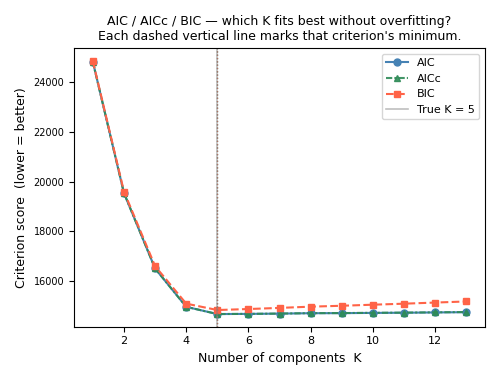
How to read the AIC / AICc / BIC curves#
Plot score (y-axis) vs K (x-axis).
The best K is at the minimum of the curve.
A sharp dip → the data strongly prefer that K.
- A flat plateau → nearby K values are nearly equivalent;
pick the smaller K (simpler is safer).
BIC minimum ≤ AIC minimum — BIC always penalises more, so its minimum shifts left. This is expected, not a bug.
Free parameter count for a full-covariance GMM on d-dimensional data#
means      :  K × d
covariances:  K × d(d+1)/2    (symmetric matrix, upper triangle only)
weights    :  K - 1           (K weights constrained to sum to 1)

Total  p = K × d  +  K × d(d+1)/2  +  (K - 1)

For d=2 (this example):  p = 2K + 3K + K - 1 = 6K - 1
For K=5:                 p = 29
This example#
We generate a 2-D dataset from K_true = 5 known Gaussian blobs. Having a ground truth lets us check whether the criteria recover the right K.
Steps:
1.  Generate 2 000 points from 5 blobs with different spreads.
2.  Fit GMMs for K = 1 … 13.
3.  Compute AIC, AICc, and BIC for each K.
4.  Pick K_best = argmin(BIC).
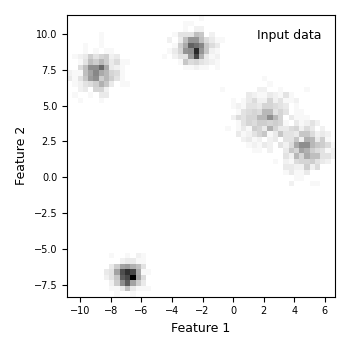
5.  Produce four plots:
      (a) raw 2-D data density (observed histogram)
      (b) AIC / AICc / BIC curves with minima marked
      (c) best-fit GMM density with component ellipses
      (d) side-by-side: observed density vs. recovered density
Dependencies: NumPy, matplotlib, scikit-learn. Nothing else.
References#
See Also#
sklearn.mixture.GaussianMixture sklearn.datasets.make_blobs
Examples#
Run as a standalone script:
python plot_gaussian_mixture_models.py
Import individual helpers inside a notebook:
from plot_gaussian_mixture_models import fit_gmm_range, draw_ellipse
# Authors: The scikit-plots developers
# SPDX-License-Identifier: BSD-3-Clause
Section 1 — Imports#
import numpy as np
import matplotlib.pyplot as plt
from matplotlib.patches import Ellipse

from sklearn.datasets import make_blobs
from sklearn.mixture import GaussianMixture

# One seed controls everything: data generation, GMM initialisation,
# and the random-state of all helper functions.
RANDOM_STATE = 42
Section 2 — Utility functions#
def _gmm_n_params(k, d, covariance_type="full"):
    """Count the number of free parameters in a fitted GMM.

    This is the ``p`` that goes into AIC, AICc, and BIC.  sklearn computes
    it internally for ``.aic()`` and ``.bic()``; we expose it here so we
    can also compute AICc.

    Parameters
    ----------
    k : int
        Number of Gaussian components.
    d : int
        Number of features (data dimensionality).
    covariance_type : {'full', 'tied', 'diag', 'spherical'}, optional
        Covariance structure.  Default is ``'full'``.

    Returns
    -------
    n_params : int
        Total number of free parameters.

    Notes
    -----
    Breakdown by covariance type (means + covariances + weights):

    full      K*d  +  K*d*(d+1)/2  +  (K-1)   — each component has its
              own full covariance matrix (most expressive, most params).
    tied      K*d  +    d*(d+1)/2  +  (K-1)   — one shared covariance.
    diag      K*d  +          K*d  +  (K-1)   — axis-aligned ellipses.
    spherical K*d  +            K  +  (K-1)   — circular blobs.

    Examples
    --------
    >>> _gmm_n_params(k=5, d=2, covariance_type='full')
    29
    >>> _gmm_n_params(k=5, d=2, covariance_type='diag')
    24
    """
    cov_params = {
        "full":      k * d * (d + 1) // 2,
        "tied":          d * (d + 1) // 2,
        "diag":      k * d,
        "spherical": k,
    }
    if covariance_type not in cov_params:
        raise ValueError(
            f"covariance_type must be one of {list(cov_params)}, "
            f"got '{covariance_type}'."
        )
    return k * d + cov_params[covariance_type] + (k - 1)


def compute_aicc(aic, n_params, n_samples):
    """Compute the corrected AIC (AICc) from a plain AIC value.

    AICc adds a finite-sample correction on top of AIC:

        AICc = AIC + 2p(p+1) / (N - p - 1)

    For large N the correction term shrinks toward zero and AICc ≈ AIC.
    For small N (rough guide: N/p < 40) the correction is meaningful and
    AICc is the safer choice over plain AIC.

    Parameters
    ----------
    aic : float
        Plain AIC value from ``GaussianMixture.aic(X)``.
    n_params : int
        Number of free parameters ``p`` in the model.  Use
        :func:`_gmm_n_params` to compute this.
    n_samples : int
        Number of training data points ``N``.

    Returns
    -------
    aicc : float
        Corrected AIC value.  Returns ``aic`` unchanged when
        ``N - p - 1 <= 0`` (degenerate case; treat result as unreliable).

    Notes
    -----
    The correction term ``2p(p+1)/(N-p-1)`` is always positive, so
    AICc >= AIC.  When N is large the denominator dominates and the
    two values converge.

    Examples
    --------
    >>> compute_aicc(aic=1000.0, n_params=10, n_samples=200)
    1001.1055276381909
    >>> compute_aicc(aic=1000.0, n_params=10, n_samples=10_000)
    1000.02202200220
    """
    denom = n_samples - n_params - 1
    if denom <= 0:
        # N is so small relative to p that the correction is undefined.
        # Return plain AIC and let the caller decide what to do.
        return aic
    return aic + 2.0 * n_params * (n_params + 1) / denom


def draw_ellipse(mean, covariance, ax, n_std=1.5, **kwargs):
    """Draw a confidence ellipse for one 2-D Gaussian component.

    The ellipse captures roughly 74 % of the probability mass for a
    2-D Gaussian when ``n_std=1.5`` (equivalent to a 1.5-sigma contour).

    Internally, we decompose the covariance matrix into eigenvalues and
    eigenvectors.  The eigenvectors tell us the orientation of the ellipse;
    the square-roots of the eigenvalues give the semi-axis lengths.

    Parameters
    ----------
    mean : array-like of shape (2,)
        Centre of the Gaussian component.
    covariance : array-like of shape (2, 2)
        2×2 covariance matrix of the component.
    ax : matplotlib.axes.Axes
        The axes to draw on.
    n_std : float, optional
        Radius of the ellipse in standard deviations.  Default is ``1.5``.
    **kwargs
        Forwarded to ``matplotlib.patches.Ellipse``.  Common ones:
        ``fc`` (face colour), ``ec`` (edge colour), ``lw`` (line width).

    Returns
    -------
    patch : matplotlib.patches.Ellipse
        The patch that was added to *ax*.

    Raises
    ------
    ValueError
        If *covariance* is not exactly 2×2.

    Notes
    -----
    We use ``np.linalg.eigh`` rather than ``eig`` because the covariance
    matrix is always symmetric.  ``eigh`` exploits symmetry for numerical
    stability and guarantees the eigenvalues come back real and sorted.

    Examples
    --------
    >>> import matplotlib.pyplot as plt
    >>> fig, ax = plt.subplots()
    >>> patch = draw_ellipse([0, 0], [[1, 0.5], [0.5, 1]], ax=ax,
    ...                      n_std=2.0, fc='none', ec='black')
    """
    covariance = np.asarray(covariance, dtype=float)
    if covariance.shape != (2, 2):
        raise ValueError(
            f"covariance must be shape (2, 2), got {covariance.shape}."
        )

    # Decompose: eigenvectors = axes directions, eigenvalues = spread along axes
    eigenvalues, eigenvectors = np.linalg.eigh(covariance)

    # Sort largest eigenvalue first (primary axis first)
    order = eigenvalues.argsort()[::-1]
    eigenvalues = eigenvalues[order]
    eigenvectors = eigenvectors[:, order]

    # Angle of the primary axis relative to the x-axis (in degrees)
    angle = np.degrees(np.arctan2(eigenvectors[1, 0], eigenvectors[0, 0]))

    # Full axis lengths = 2 × n_std × sqrt(eigenvalue)
    # np.maximum guards against tiny negative eigenvalues from floating-point
    width  = 2.0 * n_std * np.sqrt(np.maximum(eigenvalues[0], 0.0))
    height = 2.0 * n_std * np.sqrt(np.maximum(eigenvalues[1], 0.0))

    patch = Ellipse(xy=mean, width=width, height=height, angle=angle, **kwargs)
    ax.add_patch(patch)
    return patch


def fit_gmm_range(
    X,
    n_components_range,
    covariance_type="full",
    max_iter=200,
    random_state=None,
):
    """Fit one GMM per value of K and return the models plus AIC, AICc, BIC.

    We loop over every K in *n_components_range*, fit a
    ``GaussianMixture``, and collect AIC, AICc, and BIC.  All models are
    returned so the caller can inspect any of them (not just the best one).

    Parameters
    ----------
    X : array-like of shape (n_samples, n_features)
        Training data.
    n_components_range : array-like of int
        The K values to try, e.g. ``range(1, 14)`` or ``[1, 2, 5, 10]``.
    covariance_type : {'full', 'tied', 'diag', 'spherical'}, optional
        How each component's covariance is parameterised.  ``'full'``
        (default) gives the most flexible shape but uses the most
        parameters — see :func:`_gmm_n_params` for the count.
    max_iter : int, optional
        Hard cap on EM iterations per model.  Default is ``200``.
        Increase if you see ``gmm.converged_ == False`` in practice.
    random_state : int or None, optional
        Seed passed to every ``GaussianMixture`` for reproducibility.
        Default is ``None`` (non-deterministic).

    Returns
    -------
    models : list of GaussianMixture
        One fitted model per K, in the same order as *n_components_range*.
    aic_scores : list of float
        AIC for each model.  Lower is better.
    aicc_scores : list of float
        AICc for each model.  Lower is better.
        Equals AIC for large N; preferred when the dataset is small.
    bic_scores : list of float
        BIC for each model.  Lower is better.

    Raises
    ------
    ValueError
        If *n_components_range* is empty.

    Notes
    -----
    ``init_params='kmeans'`` (sklearn default) is used, which places the
    initial component centres via k-means.  This converges faster and more
    reliably than random initialisation for typical datasets.

    The AICc correction uses the free-parameter count from
    :func:`_gmm_n_params`, which replicates sklearn's internal parameter
    counting.  The three criteria should therefore be mutually consistent.

    Examples
    --------
    >>> import numpy as np
    >>> rng = np.random.default_rng(0)
    >>> X = rng.standard_normal((400, 2))
    >>> models, aic, aicc, bic = fit_gmm_range(X, range(1, 6), random_state=0)
    >>> len(models)
    5
    >>> best_k_bic = np.argmin(bic) + 1
    """
    n_components_range = list(n_components_range)
    if not n_components_range:
        raise ValueError("n_components_range must not be empty.")

    n_samples, n_features = np.asarray(X).shape
    models, aic_scores, aicc_scores, bic_scores = [], [], [], []

    for k in n_components_range:
        gmm = GaussianMixture(
            n_components=k,
            covariance_type=covariance_type,
            max_iter=max_iter,
            random_state=random_state,
        )
        gmm.fit(X)
        models.append(gmm)

        aic_val  = gmm.aic(X)
        bic_val  = gmm.bic(X)
        p        = _gmm_n_params(k, n_features, covariance_type)
        aicc_val = compute_aicc(aic_val, n_params=p, n_samples=n_samples)

        aic_scores.append(aic_val)
        aicc_scores.append(aicc_val)
        bic_scores.append(bic_val)

    return models, aic_scores, aicc_scores, bic_scores


def compute_density_grid(gmm, x_bins, y_bins):
    """Evaluate the log-density of a fitted GMM on a regular 2-D grid.

    We create a meshgrid from *x_bins* and *y_bins*, stack the grid points
    into a (n_points, 2) array, ask the GMM for its log-probability at every
    point, and reshape the result back to (n_y, n_x) so it can be passed
    directly to ``imshow(origin='lower')``.

    Parameters
    ----------
    gmm : GaussianMixture
        A fitted ``GaussianMixture`` instance.
    x_bins : array-like of shape (n_x,)
        x-coordinates of the grid (typically bin centres from a histogram).
    y_bins : array-like of shape (n_y,)
        y-coordinates of the grid.

    Returns
    -------
    log_dens : numpy.ndarray of shape (n_y, n_x)
        Log-probability density at each grid point.
        Pass ``np.exp(log_dens)`` to get plain density for ``imshow``.

    Notes
    -----
    ``score_samples`` returns ``log p(x | θ)`` — the log of the mixture
    density at each point.  We keep it in log space until plotting to
    avoid numerical underflow in sparse regions.

    Examples
    --------
    >>> import numpy as np
    >>> from sklearn.mixture import GaussianMixture
    >>> X = np.random.randn(500, 2)
    >>> gmm = GaussianMixture(n_components=2, random_state=0).fit(X)
    >>> xb = np.linspace(-4, 4, 30)
    >>> yb = np.linspace(-4, 4, 30)
    >>> ld = compute_density_grid(gmm, xb, yb)
    >>> ld.shape
    (30, 30)
    """
    xx, yy = np.meshgrid(x_bins, y_bins)
    X_grid  = np.column_stack([xx.ravel(), yy.ravel()])
    log_dens = gmm.score_samples(X_grid).reshape(len(y_bins), len(x_bins))
    return log_dens


def plot_density_panel(ax, image, extent, label, xlabel="Feature 1",
                       ylabel=None):
    """Show a 2-D density image on *ax* with consistent axes and labelling.

    Parameters
    ----------
    ax : matplotlib.axes.Axes
        The axes to draw on.
    image : numpy.ndarray of shape (n_y, n_x)
        Density values — either raw histogram counts or ``exp(log_dens)``
        from a GMM.
    extent : list of float
        ``[x_min, x_max, y_min, y_max]`` passed directly to ``imshow``.
    label : str
        Short annotation placed in the upper-right corner of the panel.
    xlabel : str, optional
        x-axis label.  Default is ``'Feature 1'``.
    ylabel : str or None, optional
        y-axis label.  Pass ``None`` to omit (useful for right-hand panels
        in a shared-axes layout).

    Returns
    -------
    ax : matplotlib.axes.Axes
        The same axes, modified in place.
    """
    ax.imshow(
        image,
        origin="lower",
        interpolation="nearest",
        aspect="auto",
        extent=extent,
        cmap="binary",
    )
    ax.text(
        0.95, 0.95, label,
        va="top", ha="right",
        transform=ax.transAxes,
        fontsize=9,
    )
    ax.set_xlabel(xlabel, fontsize=9)
    if ylabel is not None:
        ax.set_ylabel(ylabel, fontsize=9)
    ax.tick_params(labelsize=7)
    return ax
Section 3 — Generate synthetic 2-D data#
Five blobs with deliberately different spreads (cluster_std). Varying the spreads makes the problem slightly harder and more realistic than equal-variance blobs.
K_TRUE is used only for validation at the end. The GMM fitting loop below never sees this value — it has to figure out K on its own.
K_TRUE   = 5
N_SAMPLES = 2000
N_BINS    = 51

X, y_true = make_blobs(
    n_samples=N_SAMPLES,
    centers=K_TRUE,
    cluster_std=[0.6, 0.8, 0.5, 0.7, 0.9],
    random_state=RANDOM_STATE,
)
Section 4 — Fit GMMs for K = 1 … 13; collect AIC, AICc, BIC#
We fit all models upfront so Sections 5–10 are just reads — no recomputation. max_iter=300 is generous for a 2-D problem; lower values are fine too.
N_RANGE = np.arange(1, 14)

models, AIC, AICC, BIC = fit_gmm_range(
    X,
    n_components_range=N_RANGE,
    covariance_type="full",
    max_iter=300,
    random_state=RANDOM_STATE,
)
Section 5 — Pick the best model (minimum BIC)#
BIC is preferred here because our goal is recovering the true K, not maximising predictive accuracy. AICc is printed for comparison.
i_best   = int(np.argmin(BIC))
gmm_best = models[i_best]
k_best   = int(N_RANGE[i_best])

print(f"EM converged      : {gmm_best.converged_}")
print(f"BIC-optimal  K    : {k_best}           (true K = {K_TRUE})")
print(f"AIC-optimal  K    : {int(N_RANGE[np.argmin(AIC)])}")
print(f"AICc-optimal K    : {int(N_RANGE[np.argmin(AICC)])}")
print()
print("Scores at BIC-optimal K:")
print(f"  AIC  = {AIC[i_best]:.1f}")
print(f"  AICc = {AICC[i_best]:.1f}  (delta from AIC: {AICC[i_best]-AIC[i_best]:.2f})")
print(f"  BIC  = {BIC[i_best]:.1f}")
print()
n_params_best = _gmm_n_params(k_best, d=2, covariance_type="full")
ratio = N_SAMPLES / n_params_best
print(f"N / p = {N_SAMPLES} / {n_params_best} = {ratio:.1f}")
if ratio < 40:
    print("  → N/p < 40: AICc correction is meaningful here.")
else:
    print("  → N/p >= 40: AICc ≈ AIC for this dataset (correction is tiny).")
EM converged      : True
BIC-optimal  K    : 5           (true K = 5)
AIC-optimal  K    : 5
AICc-optimal K    : 5

Scores at BIC-optimal K:
  AIC  = 14675.3
  AICc = 14676.2  (delta from AIC: 0.88)
  BIC  = 14837.7

N / p = 2000 / 29 = 69.0
  → N/p >= 40: AICc ≈ AIC for this dataset (correction is tiny).
Section 6 — Build observed density (histogram) and GMM density grid#
x1_flat = X[:, 0]
x2_flat = X[:, 1]

# np.histogram2d returns counts in H[i, j] = count in bin (x_i, y_j).
# We transpose H before passing to imshow so that rows map to y and
# columns to x, consistent with origin='lower'.
H, x1_edges, x2_edges = np.histogram2d(x1_flat, x2_flat, bins=N_BINS)

x1_centres = 0.5 * (x1_edges[:-1] + x1_edges[1:])
x2_centres = 0.5 * (x2_edges[:-1] + x2_edges[1:])

log_dens = compute_density_grid(gmm_best, x1_centres, x2_centres)

# extent tells imshow the physical coordinate range of the image
extent = [x1_edges[0], x1_edges[-1], x2_edges[0], x2_edges[-1]]
Section 7 — Plot: raw observed density (what the data look like)#
This is the “before” panel — purely the data, no model involved.
fig, ax = plt.subplots(figsize=(3.5, 3.5))
plot_density_panel(
    ax,
    image=H.T,
    extent=extent,
    label="Input data",
    xlabel="Feature 1",
    ylabel="Feature 2",
)
fig.tight_layout()
plt.savefig("gmm_01_input_density.png", dpi=150)
plt.show()
Section 8 — Plot: AIC, AICc, and BIC curves#
- Reading guide (printed in the title too):
All three curves are lower-is-better.
The dip / elbow marks the recommended K for each criterion.
BIC minimum is usually at a smaller K than AIC/AICc — expected.
AICc ≈ AIC when N is large (lines nearly overlap in that case).
A flat region means the data cannot distinguish those K values well.
fig, ax = plt.subplots(figsize=(5, 3.8))

ax.plot(N_RANGE, AIC,  "-o",  color="steelblue", markersize=5, label="AIC")
ax.plot(N_RANGE, AICC, "^",   color="seagreen",  markersize=5, label="AICc",
        linestyle=(0, (3, 1, 1, 1)), alpha=0.9)   # dash-dot-dot
ax.plot(N_RANGE, BIC,  "--s", color="tomato",    markersize=5, label="BIC")

# Vertical lines mark each criterion's minimum
k_aic_opt  = int(N_RANGE[np.argmin(AIC)])
k_aicc_opt = int(N_RANGE[np.argmin(AICC)])
k_bic_opt  = k_best

ax.axvline(k_aic_opt,  color="steelblue", lw=0.9, ls=":", alpha=0.8)
ax.axvline(k_aicc_opt, color="seagreen",  lw=0.9, ls=":", alpha=0.8)
ax.axvline(k_bic_opt,  color="tomato",    lw=0.9, ls=":", alpha=0.8)

# Mark the true K with a grey bar so readers can see how close we got
ax.axvline(K_TRUE, color="grey", lw=1.2, ls="-",
           label=f"True K = {K_TRUE}", alpha=0.5)

ax.set_xlabel("Number of components  K", fontsize=9)
ax.set_ylabel("Criterion score  (lower = better)", fontsize=9)
ax.set_title(
    "AIC / AICc / BIC — which K fits best without overfitting?\n"
    "Each dashed vertical line marks that criterion's minimum.",
    fontsize=9,
)
ax.legend(fontsize=8)
ax.tick_params(labelsize=8)
plt.setp(ax.get_yticklabels(), fontsize=7)
fig.tight_layout()
plt.savefig("gmm_02_aic_aicc_bic.png", dpi=150)
plt.show()
Section 9 — Plot: best-fit GMM density + component ellipses#
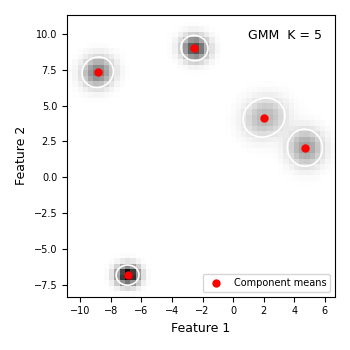
Each red dot is a component mean. Each white ellipse is the ±1.5σ confidence region of one component — roughly where 74 % of that component’s probability mass sits. If the ellipses align with the visible blobs, the model has captured the data structure well.
fig, ax = plt.subplots(figsize=(3.5, 3.5))
plot_density_panel(
    ax,
    image=np.exp(log_dens),
    extent=extent,
    label=f"GMM  K = {k_best}",
    xlabel="Feature 1",
    ylabel="Feature 2",
)

ax.scatter(
    gmm_best.means_[:, 0],
    gmm_best.means_[:, 1],
    c="red", s=25, zorder=5, label="Component means",
)

for mu, cov in zip(gmm_best.means_, gmm_best.covariances_):
    draw_ellipse(mu, cov, ax=ax, n_std=1.5, fc="none", ec="white", lw=1.2)

ax.legend(fontsize=7, loc="lower right")
fig.tight_layout()
plt.savefig("gmm_03_best_model.png", dpi=150)
plt.show()
Section 10 — Side-by-side: observed density vs. recovered density#
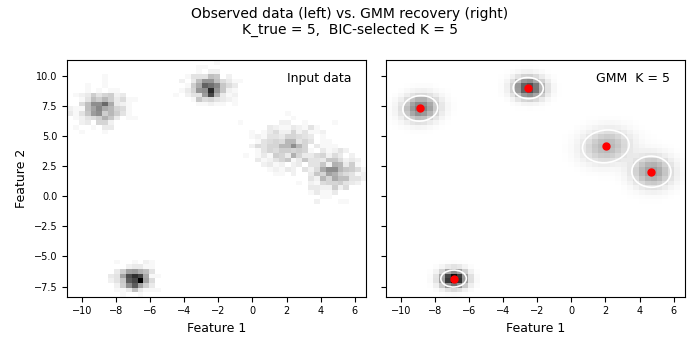
Left panel: the raw data histogram — what we measured. Right panel: the GMM density — what the model learned. Good agreement means the model captured the real structure; systematic differences reveal where the model is wrong.
fig, axes = plt.subplots(1, 2, figsize=(7, 3.5), sharey=True)

plot_density_panel(
    axes[0],
    image=H.T,
    extent=extent,
    label="Input data",
    xlabel="Feature 1",
    ylabel="Feature 2",
)

plot_density_panel(
    axes[1],
    image=np.exp(log_dens),
    extent=extent,
    label=f"GMM  K = {k_best}",
    xlabel="Feature 1",
)

axes[1].scatter(
    gmm_best.means_[:, 0],
    gmm_best.means_[:, 1],
    c="red", s=25, zorder=5,
)
for mu, cov in zip(gmm_best.means_, gmm_best.covariances_):
    draw_ellipse(mu, cov, ax=axes[1], n_std=1.5, fc="none", ec="white", lw=1.2)

fig.suptitle(
    f"Observed data (left) vs. GMM recovery (right)\n"
    f"K_true = {K_TRUE},  BIC-selected K = {k_best}",
    fontsize=10,
)
fig.tight_layout()
plt.savefig("gmm_04_comparison.png", dpi=150)
plt.show()
Total running time of the script: (0 minutes 1.470 seconds)
Related examples
Memory-Mapping Showcase – Basic / Medium / Advanced
Enhanced KISS Random Generator - Complete Usage Examples