


KissGenerator#
- class scikitplot.random.KissGenerator(bit_generator=None)[source]#
High-level random number generator using KISS algorithm.
Provides NumPy-compatible interface for common distributions with complete serialization support. For advanced distributions, wrap KissBitGenerator in numpy.random.Generator.
- Parameters:
- bit_generator{None, int, KissBitGenerator}, optional
BitGenerator or seed value
- Attributes:
bit_generatorKissBitGeneratorGets the bit generator instance used by the generator
See also
Kiss32Random32-bit version for smaller datasets
Kiss64Random64-bit version for larger datasets
KissRandomFactory function for auto-detecting
KissSeedSequenceSeed sequence for initialization
KissBitGeneratorNumPy-compatible bit generator
KissRandomStateInherites from KissGenerator
default_rngConvenience function to create generator
numpy.random.GeneratorNumPy’s Generator class
Notes
This is the recommended high-level API for most users. Provides methods similar to numpy.random.Generator.
References
[1]NumPy Random Generator API https://numpy.org/doc/stable/reference/random/generator.html
Examples
>>> gen = KissGenerator(42)
>>> gen.random(5)
>>> gen.integers(0, 100, 10)
>>> gen.normal(0, 1, 1000)
>>>
>>> # Context manager
>>> with KissGenerator(42) as gen:
...     data = gen.random(1000)
>>>
>>> # Serialization
>>> import pickle
>>> restored = pickle.loads(pickle.dumps(gen))
- bit_generator#
Gets the bit generator instance used by the generator
- Returns:
- bit_generatorKissBitGenerator
The bit generator instance used by the generator
Examples
>>> gen = KissGenerator(42)
>>> bg = gen.get_bit_generator()
>>> print(type(bg))
<class 'KissBitGenerator'>
- choice(self, a, size=None, replace=True, p=None)#
Random sample from array.
- Parameters:
- aint or array_like
If int, random sample from np.arange(a)
- sizeint or tuple, optional
Output shape
- replacebool, default=True
Whether to sample with replacement
- parray_like, optional
Probabilities for each element
- Returns:
- scalar or ndarray
Random samples
Examples
>>> gen = KissGenerator(42)
>>> gen.choice(10, size=5)
array([...])
- classmethod deserialize(cls, data)#
Deserialize a KissGenerator from a JSON-compatible dict.
- Parameters:
- datadict
Serialized generator state.
- Returns:
- KissGenerator
Fully restored generator instance.
- Raises:
- TypeError
If types are invalid.
- KeyError
If required fields are missing.
- ValueError
If state is incompatible or unsupported.
Examples
>>> import json
>>> gen = KissGenerator(42)
>>> json_str = json.dumps(gen.serialize())
>>> data = json.loads(json_str)
>>> restored = KissGenerator.deserialize(data)
- classmethod from_dict(cls, data)#
Alias for deserialize().
- get_bit_generator(self)#
Get underlying bit generator.
- Returns:
- KissBitGenerator
The bit generator
Examples
>>> gen = KissGenerator(42)
>>> bg = gen.get_bit_generator()
>>> print(type(bg))
<class 'KissBitGenerator'>
- get_params(self, deep=True)#
Get parameters (sklearn-style).
- Parameters:
- deepbool, default=True
If True, include nested params
- Returns:
- dict
Parameters
Examples
>>> gen = KissGenerator(42)
>>> params = gen.get_params()
- get_state(self)#
Get state dictionary.
- Returns:
- dict
Complete state
Examples
>>> gen = KissGenerator(42)
>>> state = gen.get_state()
>>> print("bit_generator_state" in state)
True
- integers(self, low, high=None, size=None, dtype=np.int64, endpoint=False)#
Random integers in [low, high) or [low, high].
- Parameters:
- lowint
Lowest value (inclusive)
- highint, optional
Highest value (exclusive unless endpoint=True)
- sizeint or tuple, optional
Output shape
- dtypedtype, default=np.int64
Data type
- endpointbool, default=False
If True, sample from [low, high] instead of [low, high)
- Returns:
- int or ndarray
Random integers
- Raises:
- TypeError
If a bound is not an integer (a Python or numpy integer;
boolis refused, as inindex).- ValueError
If
low >= high, or the range holds more than2**64values (more than one 64-bit draw can reach).
Notes
Unbiased (R6-1): a raw draw below
2**64 mod (high - low)is rejected before the modulo. A seeded stream equals the plain modulo’s until the first rejection (probability below(high - low) / 2**64per draw); every later output is then shifted by one draw.Examples
>>> gen = KissGenerator(42)
>>> gen.integers(0, 10, size=5)
array([...])
- normal(self, loc=0.0, scale=1.0, size=None)#
Normal distribution (Box-Muller transform).
- Parameters:
- locfloat, default=0.0
Mean
- scalefloat, default=1.0
Standard deviation
- sizeint or tuple, optional
Output shape
- Returns:
- float or ndarray
Normal samples
Notes
- Uses the Box-Muller transform:
z = sqrt(-2 * log(u1)) * cos(2 * pi * u2)
where u1, u2 are i.i.d. Uniform(0, 1).
u1 is clamped away from zero to prevent log(0) = -inf. Since KissBitGenerator.random() maps [0, 2^64-1] onto [0.0, 1.0) and zero is a valid raw value, u1 == 0.0 is possible (probability 1/2^64).
The size != None path is fully vectorized in NumPy’s C layer. No Python list or scalar boxing is performed, which avoids the GCC -Wstringop-overflow false positives triggered by Python 3.13t’s free-threaded Py_INCREF atomic operations.
Examples
>>> gen = KissGenerator(42)
>>> gen.normal(0, 1, size=1000)
array([...])
- permutation(self, x, axis=0)#
Randomly permute sequence or return permuted range.
- Parameters:
- xint or array-like
If int, permute np.arange(x). If array-like, permute copy of array.
- axisint, default=0
Axis to permute along
- Returns:
- ndarray
Permuted sequence
Notes
Unlike shuffle(), this returns a permuted copy without modifying the input.
Examples
>>> gen = KissGenerator()
>>> gen.permutation(10)  # Permuted [0, 1, ..., 9]
array([3, 7, 1, 9, 2, 5, 8, 0, 6, 4])
>>>
>>> # Permute array (returns copy)
>>> arr = np.array([1, 2, 3, 4])
>>> gen.permutation(arr)
array([3, 1, 4, 2])
>>> arr  # Original unchanged
array([1, 2, 3, 4])
- random(self, size=None, dtype=np.float64, out=None)#
Random floats in [0, 1).
- Parameters:
- sizeint or tuple, optional
Output shape
- dtypedtype, default=np.float64
Output data type
- outndarray, optional
Output array
- Returns:
- float or ndarray
Random values
Examples
>>> gen = KissGenerator(42)
>>> gen.random(5)
array([...])
- serialize(self)#
Serialize to JSON-compatible dict.
- Returns:
- dict
JSON-serializable state
Examples
>>> import json
>>> gen = KissGenerator(42)
>>> data = gen.serialize()
>>> json_str = json.dumps(data)
- set_bit_generator(self, bit_generator)#
Set new bit generator.
- Parameters:
- bit_generatorKissBitGenerator
New bit generator
- Raises:
- TypeError
If not KissBitGenerator
Examples
>>> gen = KissGenerator(42)
>>> new_bg = KissBitGenerator(123)
>>> gen.set_bit_generator(new_bg)
- set_params(self, **params)#
Set parameters (sklearn-style).
- Parameters:
- **paramsdict
Parameters to set
- Returns:
- self
Examples
>>> gen = KissGenerator(42)
>>> gen.set_params(bit_generator={"seed": 123})
- set_state(self, state)#
Set state from dictionary.
- Parameters:
- statedict
State from get_state()
Examples
>>> gen1 = KissGenerator(42)
>>> state = gen1.get_state()
>>> gen2 = KissGenerator(0)
>>> gen2.set_state(state)
- shuffle(self, x)#
Shuffle array in-place (Fisher-Yates algorithm).
- Parameters:
- xndarray
Array to shuffle
Examples
>>> gen = KissGenerator(42)
>>> arr = np.arange(10)
>>> gen.shuffle(arr)
>>> print(arr)  # shuffled
- spawn(self, n_children)#
Create independent child Generators.
- Parameters:
- n_childrenint
Number of children to spawn
- Returns:
- list of KissGenerator
Independent generators
- Raises:
- ValueError
If n_children < 1
See also
KissSeedSequence.spawnLow-level seed sequence spawning
Notes
Uses seed sequence spawning to ensure statistical independence. Each child generator has its own independent random stream.
Useful for parallel computation where each worker needs an independent RNG.
Examples
>>> gen = KissGenerator()
>>> children = gen.spawn(4)
>>> print(len(children))
3
Use in parallel computation
>>> from concurrent.futures import ThreadPoolExecutor
>>> def worker(gen):
...     return gen.random(100).mean()
>>>
>>> with ThreadPoolExecutor() as executor:
...     results = list(executor.map(worker, children))
- to_dict(self)#
Alias for serialize().
- uniform(self, low=0.0, high=1.0, size=None)#
Uniform distribution in [low, high).
- Parameters:
- lowfloat, default=0.0
Lower bound (inclusive)
- highfloat, default=1.0
Upper bound (exclusive)
- sizeint or tuple, optional
Output shape
- Returns:
- float or ndarray
Uniform samples
Examples
>>> gen = KissGenerator(42)
>>> gen.uniform(0, 10, size=5)
array([...])
Gallery examples#
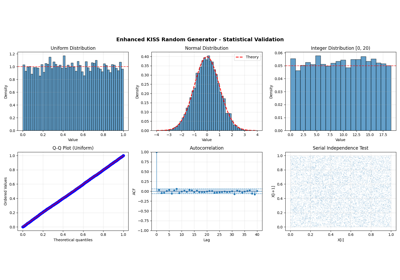
Enhanced KISS Random Generator - Complete Usage Examples