


scikitplot.corpus#
scikitplot.corpus#
Tools for turning files, URLs, media, and text sources into canonical
CorpusDocument evidence that can be transformed, embedded, stored,
searched, adapted, and exported.
See also
Choose the API that matches the job#
CorpusPipelineDirect stage control for one source or an explicit batch.
CorpusBuilderHigh-level build/search/adapt convenience for end-to-end corpus workflows.
FluentCorpusImmutable, reusable configuration. Chained setter order describes what is configured; it does not define execution order.
RuntimeCorpusThe operational form of a validated Fluent plan. Materialization constructs runtime components; source processing starts only with
run()oradd().RetrievalIndex/VectorIndexBackendLower-level retrieval and vector-backend extension APIs.
The common processing picture is:
Source
  -> Read
  -> Chunk / Normalize / Enrich
  -> Embed
  -> Store
  -> Index
  -> Retrieve
  -> Adapt / Export
Examples
Direct pipeline control:
>>> from pathlib import Path
>>> from scikitplot.corpus import CorpusPipeline, ParagraphChunker
>>> pipeline = CorpusPipeline(chunker=ParagraphChunker())
>>> result = pipeline.run(Path("article.txt"))
>>> print(f"{result.n_documents} chunks from {result.source}")
The dependency-free default sentence backend is REGEX. Passing a spaCy
model name explicitly selects the spaCy shorthand instead:
>>> from scikitplot.corpus import SentenceChunker
>>> portable = SentenceChunker()
>>> spacy_chunker = SentenceChunker("en_core_web_sm")
High-level builder:
>>> from scikitplot.corpus import CorpusBuilder, BuilderConfig
>>> builder = CorpusBuilder(
...     BuilderConfig(
...         chunker="paragraph",
...         normalize=True,
...         enrich=True,
...         build_index=True,
...     )
... )
>>> result = builder.build("./data/")
>>> results = builder.search("quantum computing")
Reusable declarative configuration:
>>> from scikitplot.corpus import FluentCorpus
>>> fluent = FluentCorpus().chunker("paragraph").storage("memory")
>>> fluent.validate()
[]
Materialization is explicit and performs no source read by itself:
>>> from scikitplot.corpus import RuntimePolicy
>>> with fluent.materialize(policy=RuntimePolicy(allow_network=False)) as runtime:
...     len(runtime.documents)
0
A configured source becomes operational only when run() is called:
>>> runtime_fluent = (
...     FluentCorpus().source("article.txt").chunker("paragraph").storage("memory")
... )
>>> with runtime_fluent.materialize() as runtime:
...     result = runtime.run()
Network and optional-capability examples:
Live URLs, OCR, ASR, spaCy, NLTK resource-backed NLP, model embeddings, and native vector backends depend on the corresponding environment capability. User-facing examples should not fabricate results when a capability is absent. Documentation/gallery examples should either use a portable executed path or report a clear skip while keeping the optional configuration visible.
URL ingestion:
>>> result = pipeline.run_url("https://en.wikipedia.org/wiki/Python")
YouTube transcript:
>>> result = pipeline.run(
...     "https://www.youtube.com/watch?v=rwPISgZcYIk"
... )
Image OCR:
>>> from scikitplot.corpus import DocumentReader
>>> reader = DocumentReader.create(Path("scan.png"))
>>> docs = list(reader.get_documents())
With model embeddings:
>>> from scikitplot.corpus import EmbeddingEngine
>>> engine = EmbeddingEngine(backend="sentence_transformers")
Dependency-free local helpers:
>>> from scikitplot.corpus import HAMLET_TEXT, HashEmbedder, SimpleEnricherSpec
>>> HashEmbedder(dimension=32)([HAMLET_TEXT[:120]]).shape
(1, 32)
>>> FluentCorpus().enricher(SimpleEnricherSpec()).validate()
[]
HashEmbedder is a deterministic lexical hashing baseline, not a learned
semantic model. HAMLET_TEXT is bundled convenience sample data rather than
an authoritative scholarly edition.
See scikitplot/corpus/README.md for the user-oriented API map, runtime
policy boundary, retrieval modes, and optional-capability guidance.
User guide. See the Corpus User Guide section for further details.
Adapter layer#
Class inheritance
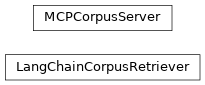
Convert |
|
Convert documents to a LangGraph-compatible state dict. |
|
Convert documents to MCP |
|
Format documents as an MCP |
|
Convert documents to a HuggingFace |
|
Convert documents to |
|
Yield documents as newline-delimited JSON strings. |
|
Convert documents to a dict of NumPy arrays suitable for batch ML. |
|
Convert documents to a |
|
Convert documents to a |
|
LangChain-compatible retriever backed by |
|
MCP server adapter for corpus search. |
Archive-within-archive#
Extract an archive to a destination directory. |
|
Check if a file path has a supported archive extension. |
Base Classes#
Class inheritance
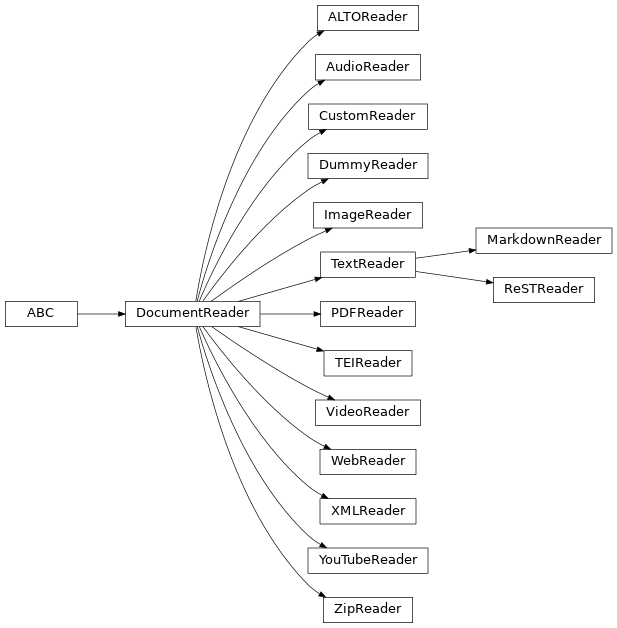
Abstract base class for all text chunkers. |
|
Standard noise filter ported and improved from remarx's |
|
Abstract base class for all format-specific document readers. |
|
A no-op reader that validates source existence and accessibility. |
|
Abstract base class for corpus document filters. |
|
Wrap any document stream with resilience, deduplication, and checkpointing. |
Chunkers#
Adapter that wraps a new-style chunker as a |
|
Bridge for |
|
Bridge for |
|
Bridge for |
|
Bridge for |
|
Wrap chunker in a bridge if it is a new-style chunker. |
|
Register a custom bridge for a user-defined chunker class. |
|
Remove a previously registered bridge for chunker_class. |
|
Structural protocol for word tokenizers. |
|
Structural protocol for sentence segmenters. |
|
Structural protocol for word stemmers. |
|
Structural protocol for word lemmatizers. |
|
Wrap any |
|
Wrap any |
|
Wrap any |
|
Wrap any |
|
Thread-safe module-level registry for named custom components. |
|
Register a named |
|
Retrieve a registered tokenizer by name. |
|
Register a named |
|
Retrieve a registered sentence splitter by name. |
|
Register a named |
|
Retrieve a registered stemmer by name. |
|
Register a named |
|
Retrieve a registered lemmatizer by name. |
|
Dominant Unicode script detected in a text sample. |
|
Detect the dominant Unicode script in text. |
|
Return |
|
Return |
|
Split text into individual CJK character tokens. |
|
str(object='') -> str str(bytes_or_buffer[, encoding[, errors]]) -> str |
|
Produce fixed-size sliding-window chunks over a document. |
|
Configuration for |
|
Unit of measurement for window size and step. |
|
frozenset() -> empty frozenset object frozenset(iterable) -> frozenset object |
|
Normalise any language specifier into a list of canonical NLTK names. |
|
Return a frozenset of stopwords for one or more languages. |
|
Resolve an ISO 639-1/639-3 code to a canonical NLTK language name. |
|
Resolve a canonical NLTK language name to its primary ISO 639-1 code. |
|
Split a document into paragraph-level |
|
Configuration for |
|
Supported sentence-splitting backends. |
|
Split a document into sentence-level |
|
Configuration for |
|
Lemmatization backend. |
|
Stemming algorithm. |
|
Stopword list source. |
|
Word tokenisation backend. |
|
Process a document at word level, producing normalised token chunks. |
|
Configuration for |
Corpus Builder#
Class inheritance
Result of a corpus build operation. |
|
Configuration for |
|
Unified corpus builder — end-to-end pipeline orchestrator. |
Custom Hooks#
Component factory callables for |
|
Wrap any callable as a |
|
Custom backend callables for |
|
Wrap any callable as a |
|
|
|
Wrap any callable as a |
|
|
|
|
|
|
|
Lifecycle callbacks for |
Downloader#
Class inheritance
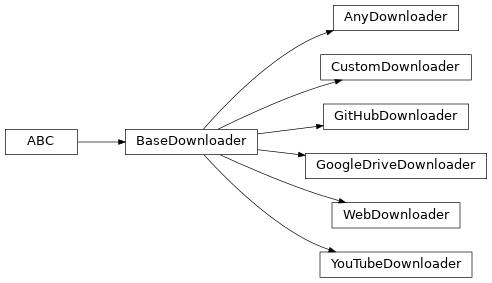
Auto-dispatching downloader with multi-URL and per-parameter list support. |
|
Abstract base class for all format-specific URL downloaders. |
|
Wraps a user-supplied callable as a |
|
Immutable result object returned by every |
|
GitHub URL downloader with automatic blob → raw normalisation. |
|
Google Drive share-link downloader. |
|
Generic HTTP/HTTPS file downloader. |
|
YouTube content downloader. |
Embeddings#
Path subclass for non-Windows systems. |
|
str(object='') -> str str(bytes_or_buffer[, encoding[, errors]]) -> str |
|
Multi-backend sentence embedding engine with SHA-256 file caching. |
|
str(object='') -> str str(bytes_or_buffer[, encoding[, errors]]) -> str |
|
str(object='') -> str str(bytes_or_buffer[, encoding[, errors]]) -> str |
|
str(object='') -> str str(bytes_or_buffer[, encoding[, errors]]) -> str |
|
Export a corpus with embeddings to LLM training formats. |
|
Unified embedding engine for any |
Enricher#
frozenset() -> empty frozenset object frozenset(iterable) -> frozenset object |
|
Configuration for |
|
Pipeline component that populates NLP enrichment fields on |
Export#
Export a list of documents to |
|
Load |
Metadata#
Descriptor for a named corpus collection. |
|
Aggregate statistics over a |
|
Compute aggregate statistics over a document collection. |
|
Extract provenance metadata from a source filename using heuristics. |
Normalizers#
Remove exact duplicate lines while preserving first-occurrence order. |
|
Remove HTML and XML tags from the document text. |
|
Detect document language and set |
|
Convert the document text to lowercase. |
|
Apply a sequence of normalisers in order. |
|
Abstract base class for all text normalisers. |
|
Apply Unicode normalisation (NFC, NFD, NFKC, or NFKD). |
|
Collapse runs of whitespace and optionally strip leading/trailing space. |
|
Pipeline component that populates |
|
Configuration for |
|
Normalise text according to config. |
Pipeline#
Class inheritance
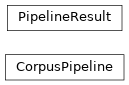
Orchestrates the full corpus ingestion pipeline. |
|
Immutable summary of a single pipeline run. |
|
Create and export a corpus from a single source file. |
Readers#
Class inheritance

ALTO XML reader for scanned document archives. |
|
Text extraction from audio files via companion transcript/lyrics parsing, Whisper ASR, and optional audio classification. |
|
Fully user-customizable reader for any file extension and resource type. |
|
Coerce an extractor return value to a list of raw chunk dicts. |
|
OCR-based text extraction from raster image files. |
|
PDF document reader with pdfminer.six → pypdf cascade. |
|
Markdown document reader. |
|
reStructuredText document reader. |
|
Plain-text document reader. |
|
Text extraction from video files via subtitle parsing and/or automatic speech recognition. |
|
Fetch a web page and extract structured text via BeautifulSoup. |
|
Extract the transcript of a YouTube video using |
|
TEI/XML document reader with dramatic structure extraction. |
|
Generic XML document reader with configurable XPath. |
|
Generic ZIP archive reader — dispatches each member to its natural reader. |
Registry#
Central look-up table for corpus pipeline components. |
|
Central look-up table for corpus pipeline components. |
Similarity#
Configuration for similarity search. |
|
A single search result. |
|
Multi-mode similarity index over |
Schema#
Semantic label for the role of a text chunk within its source document. |
|
Describes how a |
|
Supported serialisation targets for a completed corpus. |
|
Semantic label for the kind of source from which a document was read. |
|
Search mode for intertextual matching queries against a corpus index. |
|
Primary content modality of a |
|
Per-document error handling behaviour for |
|
Canonical representation of a single text chunk in a processed corpus. |
|
frozenset() -> empty frozenset object frozenset(iterable) -> frozenset object |
|
Convert a list of |
|
Convert a list of |
Source#
Declarative descriptor for one or more document sources. |
|
A single resolved source entry yielded by |
|
Discriminant for the kind of source an entry represents. |
Storage#
Class inheritance
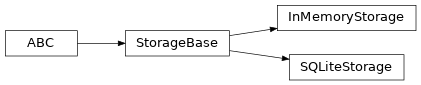
Thread-safe in-memory dict store. |
|
Append-friendly JSONL (newline-delimited JSON) flat-file store. |
|
Result container returned by |
|
SQLite-backed corpus store with FTS5 full-text search. |
|
Abstract base class for all corpus storage backends. |
|
Query parameters for |
URL#
Classification of a URL for routing to the correct handler. |
|
Classify a URL into one of the known |
|
Download a URL to a local file. |
|
Infer a file extension from HTTP response headers and URL path. |
|
Probe a URL with a HEAD request to classify by Content-Type. |
|
Resolve a provider-specific URL to a direct-download URL. |